

Turn AI governance into evidence.
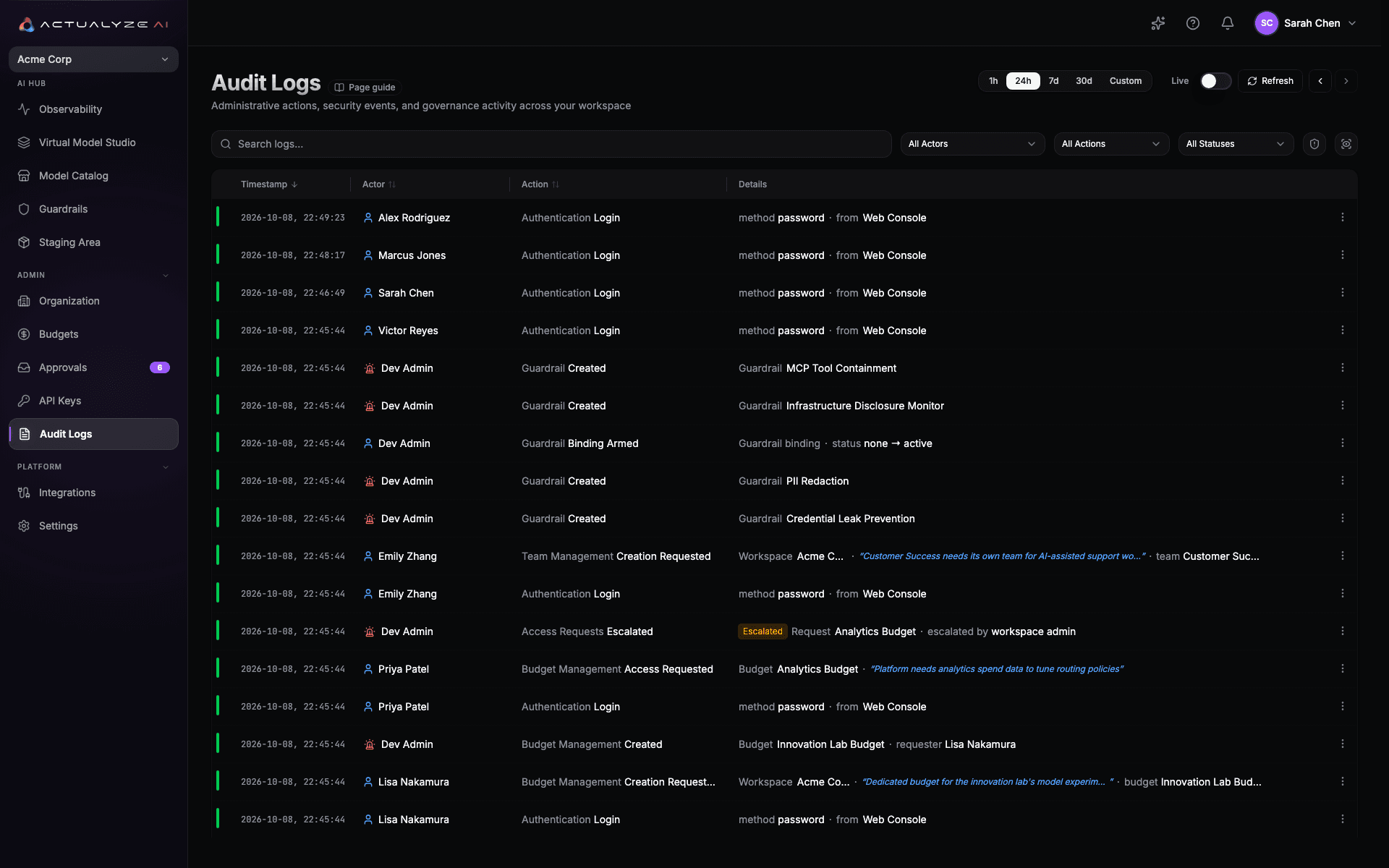
Every request and every governance action — who, what, when, under which policy — written to an append-only trail as it happens. When the auditor asks, the answer is an export, not a project.
Your controls exist. Your evidence doesn't.
Most organizations govern AI better than they can prove, because the proof lives in scattered provider logs, screenshots, and spreadsheets assembled after the fact.
Evidence by scavenger hunt
Each audit means weeks of pulling provider logs, exporting dashboards, and reconstructing who approved what from email threads.
Policy vs. practice
The policy says reviews happen and data rules apply. Nothing at runtime records they actually did, so attestations rest on trust, not records.
Frameworks moved in
SOC 2, ISO, HIPAA, and the EU AI Act now treat AI usage as a control to evidence, with retention rules your current logging was never built for.
Evidence assembled after the fact is evidence that can be questioned.
Auditors and customers no longer accept 'we have a policy.' They ask who accessed which model, when, under what rule; and expect the answer from a system, not a memory.
Reconstructed evidence is expensive and fragile; every audit re-runs the same scramble, and every gap becomes a finding.
The lasting fix is architectural. When enforcement and evidence come from the same system, proving compliance stops being separate work.
The control plane writes your evidence as it works.
Route AI through one governed plane and the audit trail assembles itself; every request, approval, and override captured in a form you can hand over.
An append-only record of everything
Every request and governance action is written to an append-only trail: who acted, on what, when, under which policy, and the outcome. Entries are never rewritten or erased, and an attempt to tamper with the record is itself recorded. Even access to the audit trail is itself audited.
- Who, what, when, and which policy per request
- Append-only by construction, tamper attempts recorded
- Audit access is itself audited
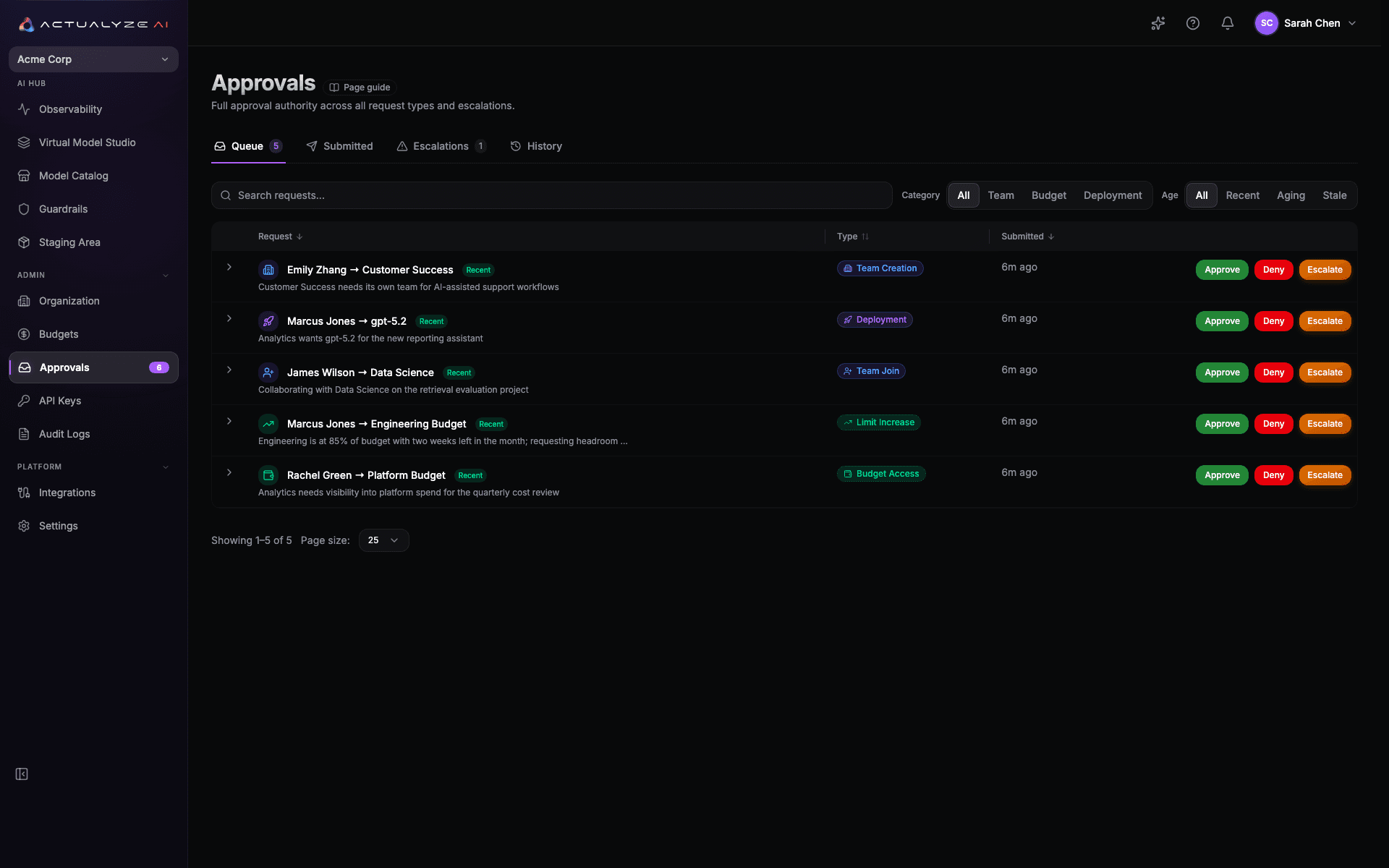
Approvals and overrides, captured live
Access requests, approvals, and escalations are recorded with their approver as they happen. Admin force-adds and FinOps budget overrides are specially flagged and require justification, and Governance Signals push them to the people accountable, in real time or as a digest. The exceptions auditors care about most are the best-documented.
- Every approval recorded with its approver
- Overrides and force-adds flagged, justification required
- Governance Signals surface exceptions as they happen
Evidence in the shape your auditors expect
The evidence your obligations require is captured by default. Export the trail as structured CSV or JSON into your SIEM or compliance stack, and search the full window when needed.
- Data logs for SOC 2, HIPAA, SOX and other common compliance needs
- Structured CSV / JSON exports available
- Easily search and filter for the evidence you need
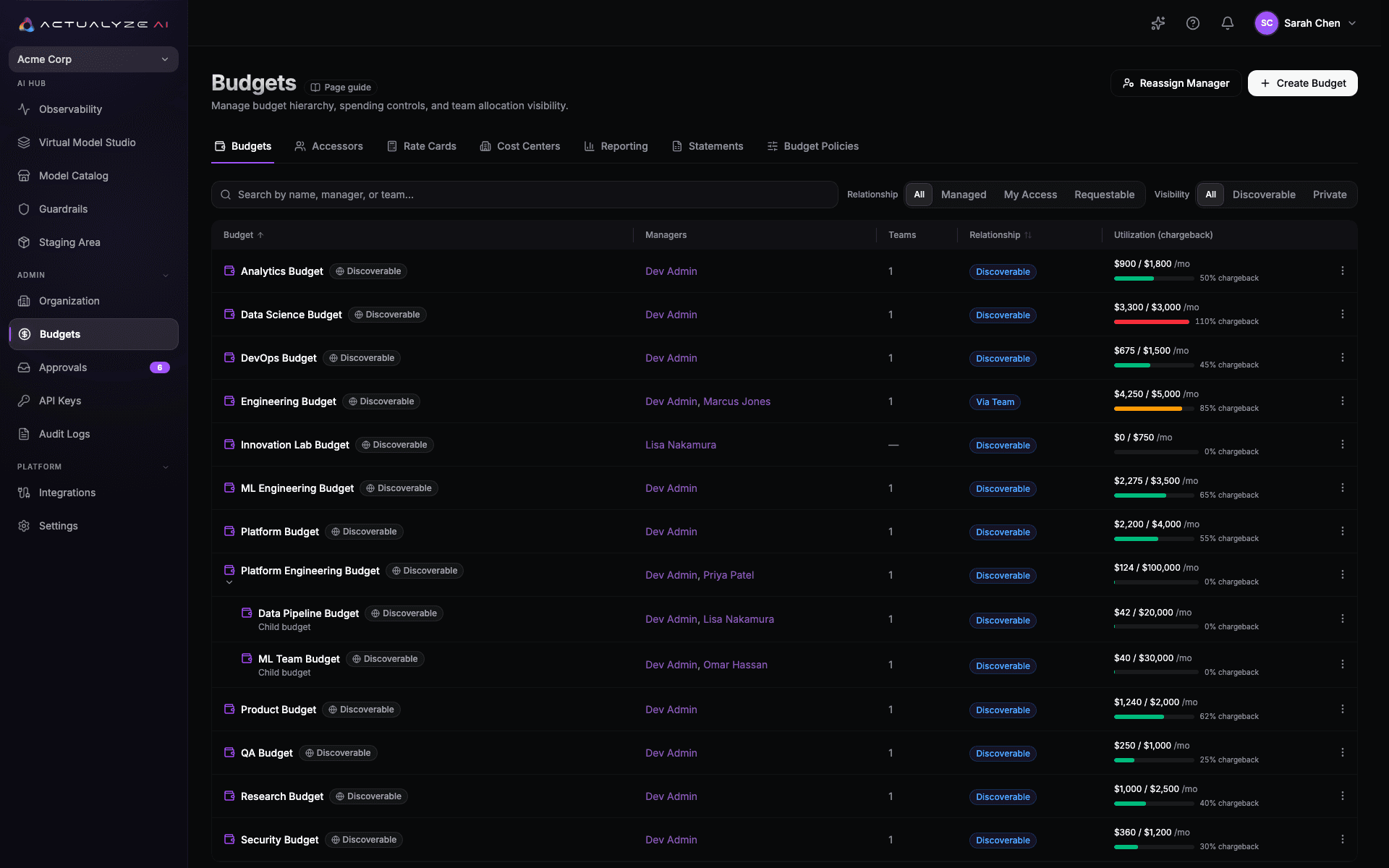
Every part of the platform leaves an audit trail.
Compliance is built into the platform. Each piece of the control plane logs to the audit trail so you can see every action, approval, and call.
Questions about proving compliance.
What does the audit trail actually capture?
Can the trail be edited after the fact?
Does the audit log expose our prompts to auditors?
How long is the trail retained?
Can we ingest the trail into our SIEM?
What about emergency actions and admin overrides?
Walk into the audit with the evidence ready.
Put the controls in the request path and the evidence writes itself.