

Bring shadow AI into the light.
Personal keys, expensed subscriptions, and unsanctioned tools didn't appear because people are reckless; they appeared because the sanctioned path was slower. Actualyze replaces them with a governed path teams actually prefer, and puts your domain's members under one sign-in policy.
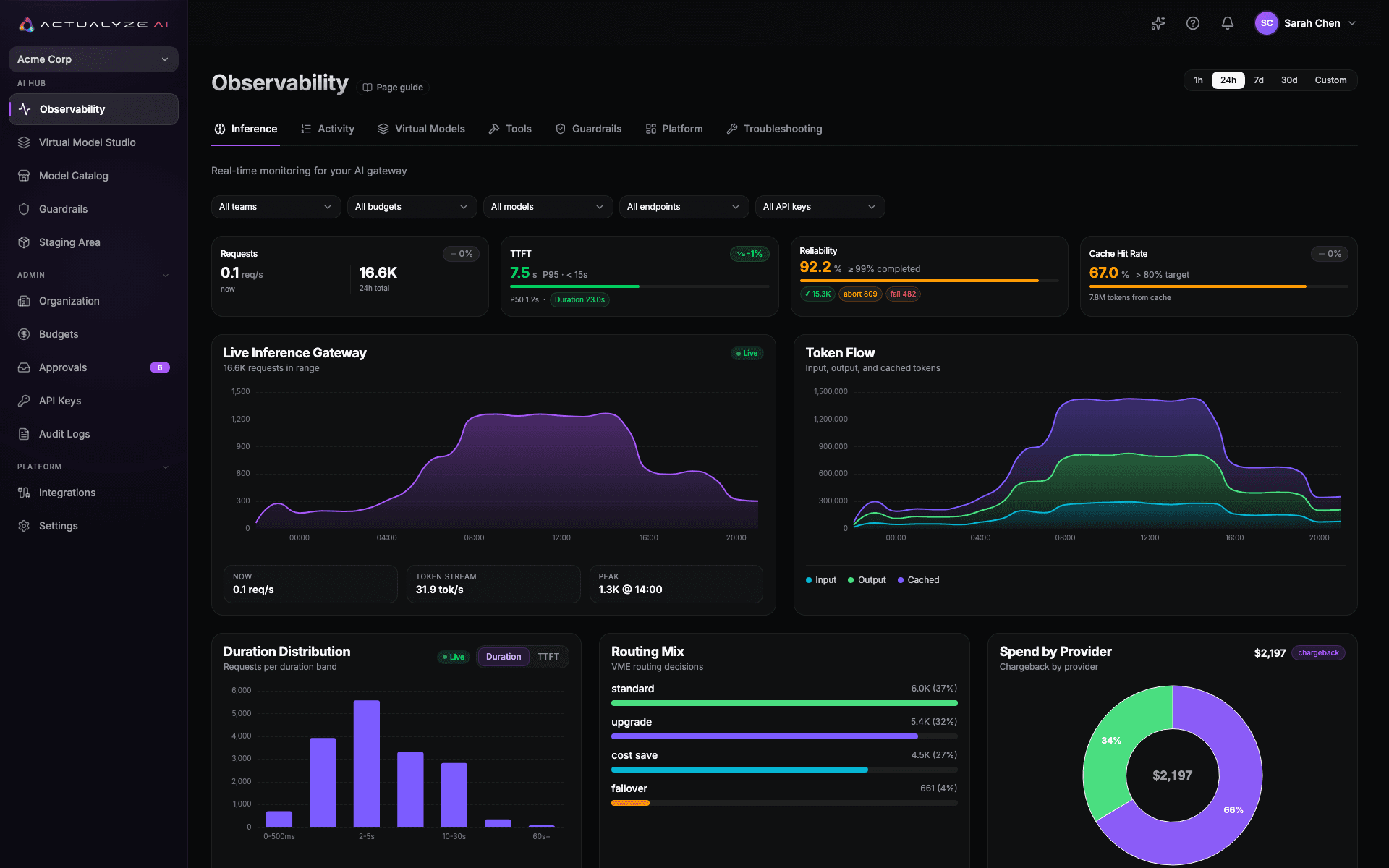
AI adoption doesn't wait for permission.
Employees bring their own models the moment they prove useful; through personal accounts, raw API keys, and tools nobody vetted.
Personal keys everywhere
Work flows through personal ChatGPT and Claude accounts and API keys on random credit cards. Security never sees a single request.
Data walks out
Prompts carry customer data and source code into tools with no policy, no redaction, and no record of what left.
Bans push it deeper
Blocking the tools people rely on doesn't stop usage. People route around the ban, and you lose what visibility you had.
Shadow AI is unmet demand from your users. Give them what they want.
People use unsanctioned AI because it makes them faster. Banning doesn't remove the demand; it removes your visibility into it.
The exposure compounds quietly: every ungoverned prompt is data you can't account for, from an identity you don't control, on a bill you can't see.
The fix isn't a bigger blocklist. It's a sanctioned path that is genuinely better, faster to adopt, with more models to use, plus control over how the people on your domain sign in.
Make the governed path the easy path.
Actualyze reduces shadow AI on three fronts: a sanctioned path teams prefer, visibility into every call routed through it, and control over how your domain's members sign in.
A sanctioned path teams prefer
One OpenAI-compatible endpoint in front of a curated catalog of models, more than any personal account offers. Teams self-serve access and budgets instead of waiting on tickets, so the governed route is also the fastest one.
- OpenAI-compatible; adopt by changing one URL
- Curated catalog across providers
- Self-serve teams and budgets, approvals where needed
Visibility into all of it
Every call through the platform is metered in one ledger, attributed to the team, budget, and API key that drove it. Usage that isn't on the governed path stops being invisible. It stands out.
- Every governed call metered in real time
- Attribution by team, budget, and API key
- Off-path usage stands out against the ledger
Your domain, under one policy
Claim your email domain with DNS verification, then require SSO for your members on it. Roll enforcement out in monitor mode with a grace period, see which members still sign in outside policy, and keep break-glass access for when the identity provider is down. When someone leaves, deactivating them ends their sessions and revokes their keys.
- DNS-verified domain authority
- SSO enforcement; monitor first, then enforce
- SCIM deprovisioning for departures
Every part of the platform removes a reason to go around it.
Shadow AI survives on friction. Each piece of the control plane takes away one of the reasons people route around IT.
Questions about shadow AI.
Does Actualyze scan our network to find shadow AI tools?
What about the personal subscriptions employees expense?
Won't developers just route around the platform?
Can we require SSO for everyone on our email domain?
What happens to the raw provider keys teams already use?
Do we have to block direct access to inference providers to make this work?
Turn shadow AI into governed AI.
Give your teams a governed path that's faster than the workaround, then see, secure, and govern what you couldn't before.