

Prove control over every request without slowing the business down.
Put guardrails, identity, and data rules in the path of every model call, and capture an audit trail by default. Show exactly who used what, when, and under which policy. Govern AI instead of blocking it.
AI moved faster than your controls.
Teams adopted models and agents through personal keys and SaaS tools before security ever saw a request, leaving you to govern something you can't see.
Invisible usage
Models reach production through personal keys and unmanaged tools. You can't secure, support, or attest to traffic you never observed.
No evidence trail
When an auditor or customer asks who accessed what, the answer lives in scattered provider logs, or nowhere at all.
Policy by PDF
Data-handling and model rules sit in a doc nobody enforces at runtime. Stated policy and real behavior quietly drift apart.
AI is now in scope for every framework you answer to.
From SOC 2 and ISO to HIPAA, model usage is now a control you have to evidence, not an exception you can footnote.
Prompts carry PII, secrets, and source code. Each uncontrolled call is a potential exfiltration route you can't currently close.
When an ungoverned model leaks or hallucinates into production, security and compliance own the exposure, whoever shipped it.
Controls in the path, evidence by default.
Route every model call through one governed plane where guardrails run inline, access maps to your org, and an immutable record is written for every request.
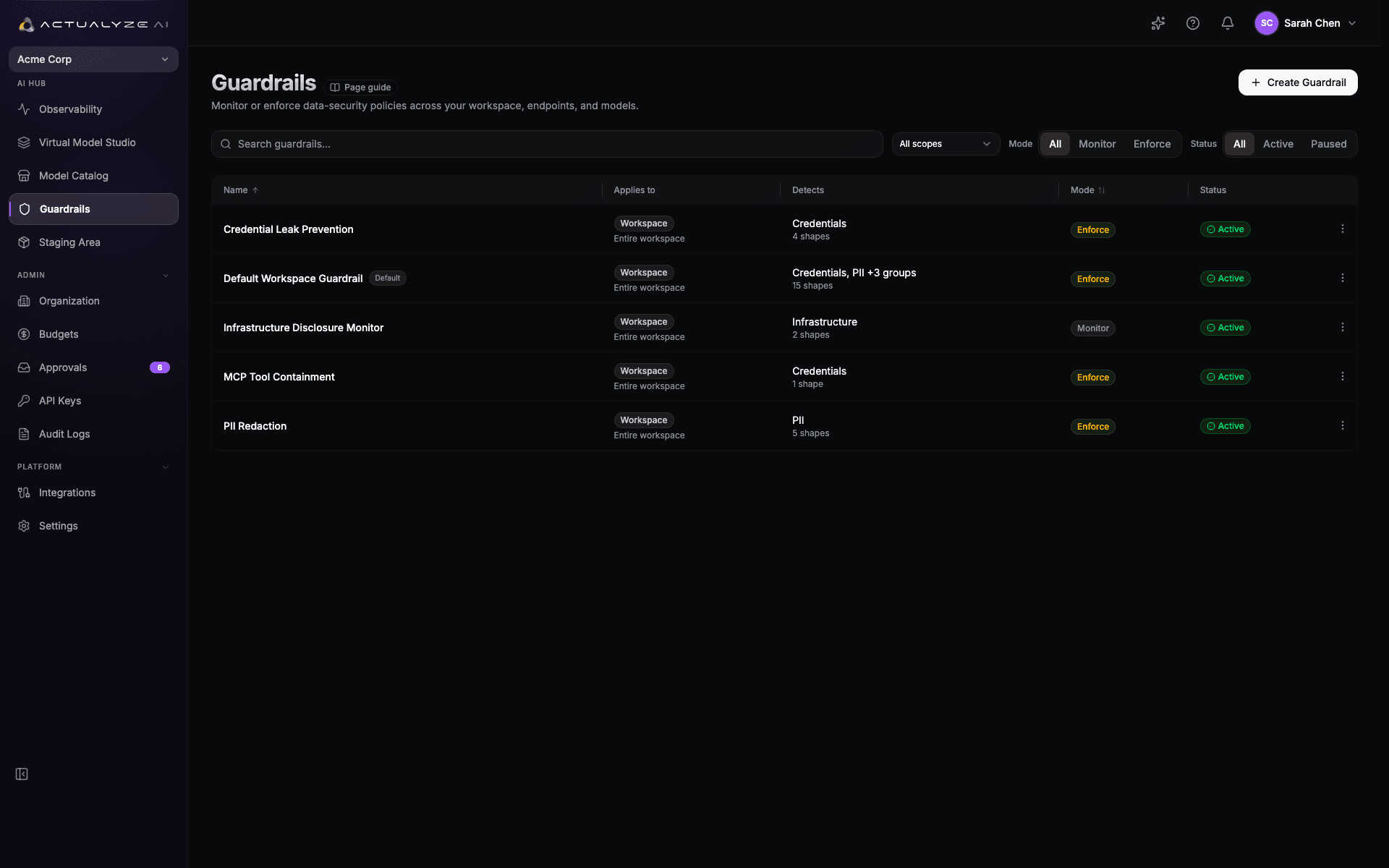
Guardrails on every call
PII and secrets masking runs inline on every prompt before it reaches a model, and on every response on its way back. Tool-call controls stop an injected prompt from moving data out through a tool. Every detection and blocked tool call is logged, never silently dropped.
- PII and secrets masking
- MCP tool allowlists, URL filtering, and result scanning
- Every guardrail action logged with its configuration
Policy that maps to your org
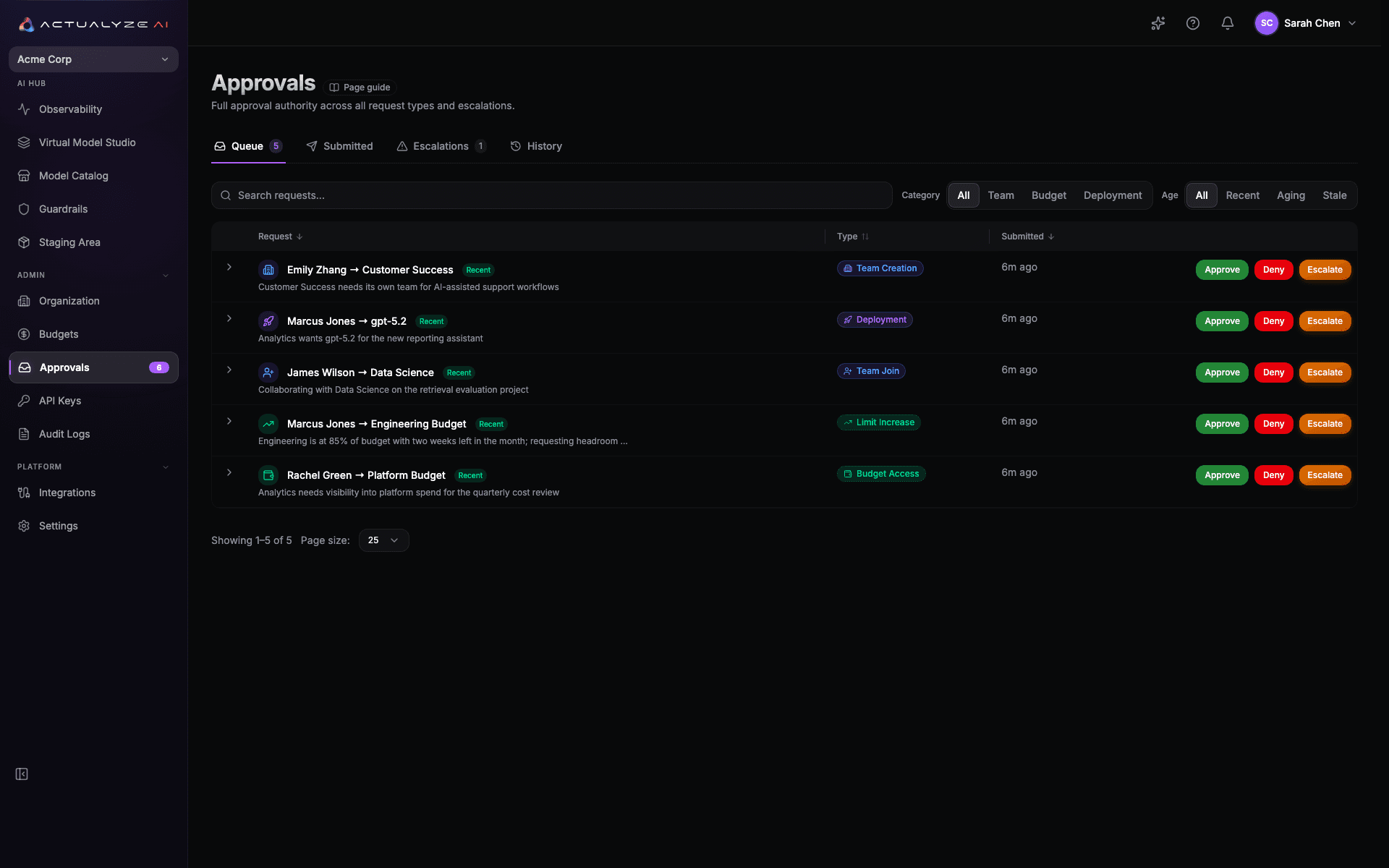
Sign-in runs through your SSO identity provider (SAML), and teams can be imported from its directory groups. Per-team and per-model data rules are enforced live on every request, not described in a document.
- SSO through your identity provider (SAML)
- Per-team, per-model data rules
- Policy enforced live, not by doc
An audit log you can hand to auditors
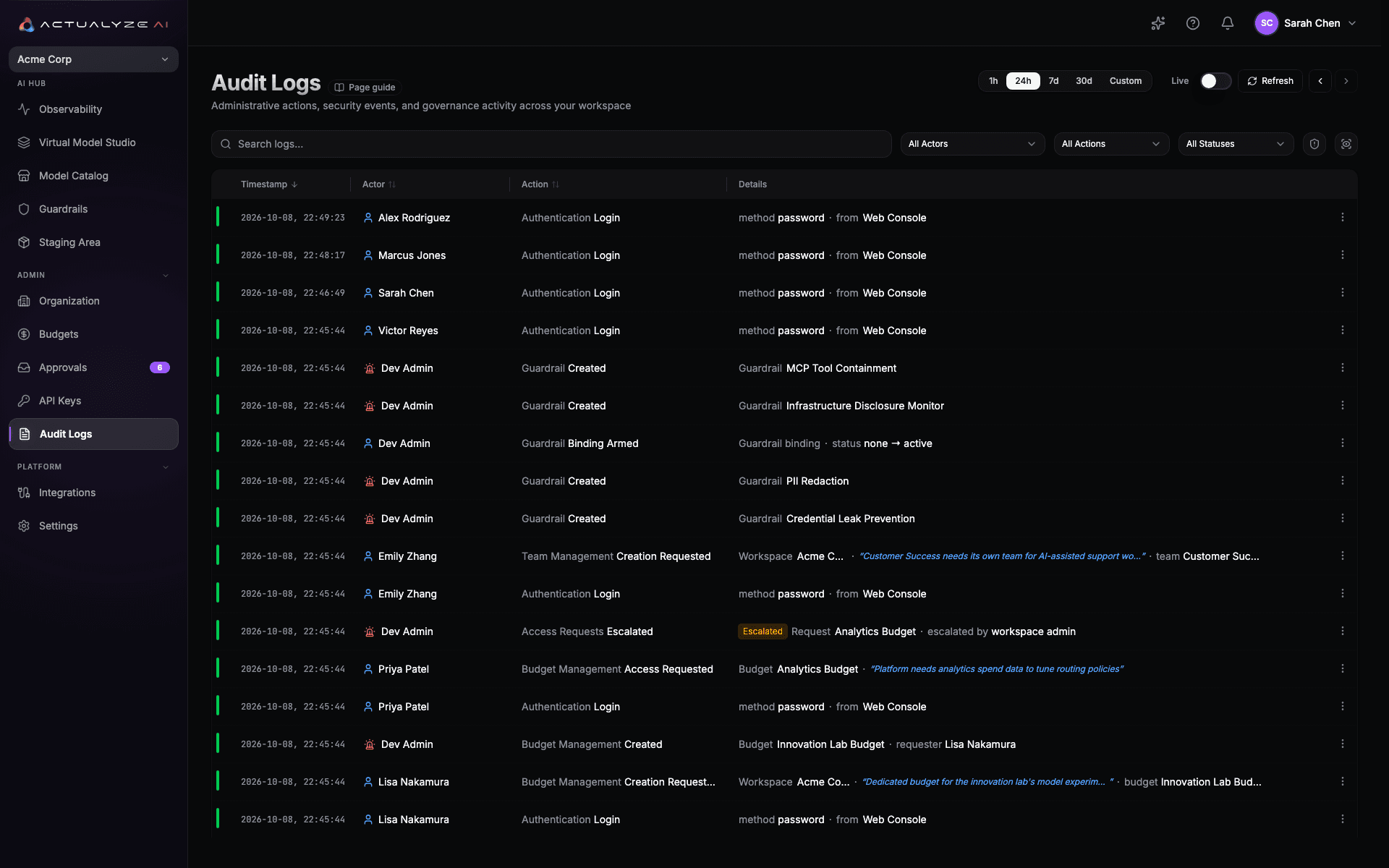
Every request is captured immutably. Who, what, when, and under which policy. Exportable as structured CSV or JSON you can hand to your SOC 2, ISO, or HIPAA evidence process.
- Every request captured immutably
- Who, what, when, which policy
- Export for SOC 2, ISO, and other common compliance needs
One control plane carries the evidence for you.
Each part of Actualyze turns a security or compliance requirement into something enforced and recorded automatically, so governing AI doesn't mean standing in the way.
Questions from security teams.
How does Actualyze help with SOC 2, ISO, or other regulatory needs?
Can it stop PII or secrets from leaving in a prompt?
Does it use our existing identity provider?
How do we surface and shut down shadow AI?
What does the audit trail actually capture?
Does adding controls slow developers down?
Govern AI. Don't block it.
Stand up the controls and the evidence trail your frameworks require, without becoming the team that says no.